(Originally published as part of the Faith in Action Climate Series at St. Mary’s Anglican Church in April 2022.)
It’s Friday afternoon. I’m driving home in a car that smells like that food left at the back of the fridge. Gibson, our four-year-old, pinches his nose and asks me to roll down the windows.
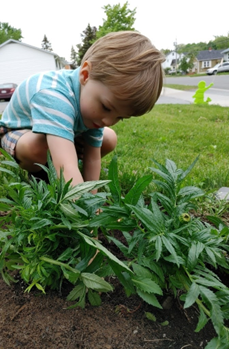
The smell comes from food scraps collected from Gibson’s daycare. The kids are learning about composting, and we’re bringing the food scraps home to our compost bin.
We may think that soil is pretty inert other than some bugs and worms, but nothing could be farther from the truth! Healthy soil has an entire food chain of microorganisms that actually provide nutrients for plants – between 100 million and 1 billion in each teaspoon! [1] These microbes eat organic matter, get eaten by other microbes, and excrete organic matter to continue the cycle. Plants tap into this cycle, absorbing nutrients before it gets eaten by something else. Since these microbes don’t wash away, this cycle of life and death continues to recycle organic matter and provide nutrients for plants.
By contrast, industrial agriculture uses chemical fertilizer to provide nutrients for plants. The chemicals disrupt the soil food web and then the plants become dependent on the chemicals. When chemical fertilizers get washed away by rain, they pollute waterways and fuel algae growth, killing fish and other sea creatures. And finally, we waste a lot of food (almost half of what is produced! [2]) in grocery stores, restaurants, and the back of our fridges! Food in the landfill breaks down without oxygen, creating methane gas, which is 25 times more harmful to the environment than carbon dioxide. [3]
What can we do in the face of these overwhelming issues? A simple first step is composting.
Organic matter from rotting food builds the living soil food web. Feeding the soil microorganisms feeds the plants, and we eat the plants. What we don’t eat goes into the compost bin, closing the loop and allowing natural processes to create life from death. Even if you’re not growing food, composting captures carbon, keeping it out of the atmosphere. [4]
Composting is one of those everyday miracles in this incredibly well-designed system we call nature. When we compost the food scraps – from our own kitchen or from Gibson’s daycare – we are doing our part to give back to the soil microbes who enable us to grow the food we eat everyday.
For further reading:
 Oasis Farmery