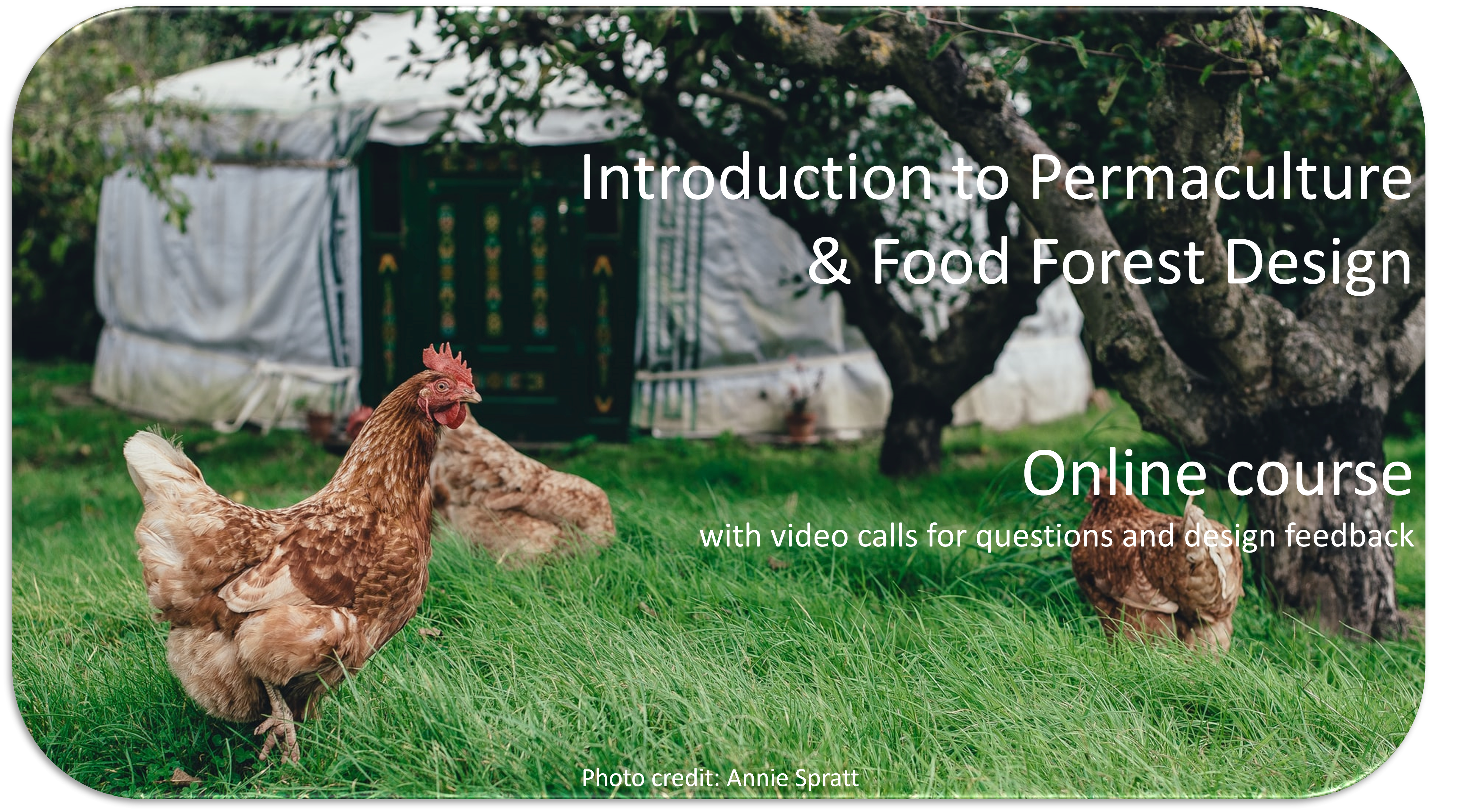
This course is designed to guide you through the process of creating your own food forest or permaculture property design. Learn about permaculture principles, ethics, and design tools to create abundance in your life and join the movement to create a hopeful flourishing future.
The 7-module online course can be completed in 7 weeks, or you can adapt the pace to your schedule. At the end of each module, you can schedule a video call with Andrew to ask questions and get feedback on your design. Each module of the Google Classroom-based course includes discussion questions to interact with other participants, handouts to guide key design steps, and links to additional material to further explore the concepts.
In-person offerings of this course are taught in Fredericton, New Brunswick in October and February. To give more time for learning activities and forming connections between participants, the in-person course has been expanded to an 8 week course. If you are interested in taking the course in-person, send us an email.
“Thank you, Andrew, for this terrific learning experience! It’s life changing, truly.”
Janice Wright-Cheney
“I was interested in learning more about Permaculture and food forest systems but was feeling overwhelmed and didn’t know where to start.
Through Honeybee Folk School I signed up for the Intro to Permaculture class with Andrew Mathis from Oasis Farmery.
Throughout the 7 week class Andrew taught us about permaculture, design, and food forest systems. He took us on field trips and guided us through the steps to transform our own spaces into abundant food forests. He encouraged us to get to know our own spaces on a deeper level, to create clear goals and vision statements, and finally to concrete designs. The information he shared was easily followed, understood, digestible, and he always included extra supplemental learning that we could look at in between classes. His enthusiasm, knowledge and passion for this subject made learning interesting and fun.
I left this program feeling confident in my new knowledge and my ability to apply what I have learned to create my own food forest system that will benefit many for years to come.”
Julie Zaat
“This course was wonderful! It felt like a great step forward in learning, with lots of inspiration and ideas, and useful resources to use going forward. Andrew did a great job of creating a warm and welcoming environment and fostering each of our learning. It was apparent that he had put a lot of thought and preparation into delivering this course. Through working on our own projects, and site visits, we were able to observe and try out elements of the permaculture design process. Meeting Andrew and the other participants was a highlight, as they are also interested in growing plants and building communities and regenerating land. This coming growing season, I look forward to implementing the design developed for our property, and hope there are ongoing opportunities to connect with this new group of friends and the broader permaculture community. It was a pleasure to take part in this class!”
Ryan Brennan
“Andrew is a natural teacher who thoughtfully and effectively conveys an impressive range of content—from the theoretical to the highly practical. With genuine enthusiasm he teaches why permaculture is important and how it can be applied. I left the course with a solid grasp of permaculture concepts as well as a concrete plan for my own food forest.”
Tom Cheney
“Andrew learned the course content himself and practices it by actually living it. This makes him an excellent teacher because he draws from his own experience. The course has helped me set and define real timeline life goals with respect to integrating with my natural surroundings.”
Mike Sharp
Permaculture
Course Learning Outcomes
At the end of this course, participants will be able to:
• explain the difference between the regenerative and sustainable paradigms,
• apply the permaculture principles and ethics to their own lives,
• apply the permaculture design process and tools to create abundance,
• and design either a small guild for a particular site, or an entire food forest.
Permaculture
Course overview
- Introduction
- Climate Paradigms
- Permaculture Principles and Ethics
- Permaculture Tools
- Patterns
- Yeomans’ Scale of Permanence
- Needs & Yields
- Zones & Sector Analysis
- Forest Gardens
- Introduction
- Plants & their Functions
- Design Process
- Goal Articulation
- Site Analysis & Assessment
- Design
- Design Concept
- Schematic Design
- Patch & Guild Design
- Implementation
- Design Evaluation
- Conclusion
- Sharing your design
- What’s next?
Register now!
Online course: $350 plus tax
In-person course: $400 plus tax
Learning is more fun with a friend! Register with a friend and each get 10% off! (Email OasisFarmery@gmail.com with your friend’s name to get the discount code before booking.)
March 2026 in-person course registration: https://www.eventbrite.ca/e/1983779020452?aff=oddtdtcreator
Online course registration: https://www.eventbrite.ca/e/1983783522919?aff=oddtdtcreator
 Oasis Farmery